> For the complete documentation index, see [llms.txt](https://helpdesk.getfly.vn/llms.txt). Markdown versions of documentation pages are available by appending `.md` to page URLs; this page is available as [Markdown](https://helpdesk.getfly.vn/web-version/images-and-media/warehouse-module/creating-and-managing-warehouses.md).
# Creating and Managing Warehouses
## 1. Create, Edit, and Delete a Warehouse
### 1.1. Create a New Warehouse
To create a new warehouse, go to Inventory module → select Warehouse → click Add new.
The "Add New Warehouse" screen includes the following fields:
(1) Warehouse Name: The name of the warehouse you want to create.
(2) Warehouse Code: A code used when uploading purchase or sales orders to identify the source/destination warehouse.
(3) Warehouse Address: Used to identify the physical location of the warehouse.
(4) Warehouse Phone Number (optional).
(5) Warehouse Manager: Assign the person responsible for this warehouse. This user will be authorized to finalize import, export, and inventory check processes.
(6) Related Users: Assign users who can access this warehouse and check inventory levels.
After filling in the required information, click Add new to create the warehouse.
### 1.2. Edit a Warehouse
To edit an existing warehouse:\
Go to Inventory → Warehouse, select the warehouse you want to update from the list, and click Edit.
### 1.3. Delete a Warehouse
To delete a warehouse:\
Go to Inventory → Warehouse, select the warehouse you wish to delete.
Note:
Before deleting, ensure all stock in the warehouse is transferred to another warehouse.
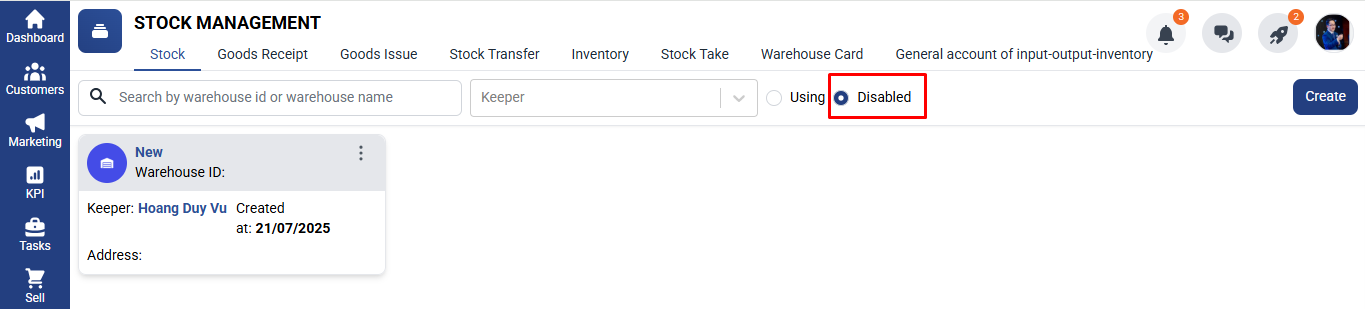
Deleted warehouses will be moved to the Deleted section and can be restored if needed.
## 2. Configure Warehouse Workflows
### 2.1. Enable/Disable Warehouse Approval Workflow
To use warehouse approval workflows in Getfly CRM, you must first enable the global approval setting.
Go to Settings → System Configuration → CRM Settings → Approval Workflow → enable Use warehouse approval workflow.
Enable: Allows creation of export slips even if stock is insufficient (pending approval).
Disable: Disallows creation of export slips when stock is unavailable.
### 2.2. Configure Import, Export, and Inventory Check Workflows
Once the warehouse workflow is enabled, you can set up detailed workflows for each warehouse.
Go to Inventory → Warehouse → Edit Warehouse → Workflow Setup.
Define the following:
(1) Who can request stock import: Choose users allowed to create import slips.
(2) Who finalizes the import process: The assigned warehouse manager is the default approver, but you can specify additional users to finalize the process in their absence.
(3) Additional approvers: If selected, the additional approver must approve first, followed by the final approver to complete the workflow.
You can set up similar workflows for stock exports and inventory audits.
Click Add new to save the workflow.
## 3. Warehouse Management
Access the warehouse list by navigating to Inventory → Warehouse. The list displays all warehouses in the system.
Available options include:
(1) Search: By warehouse code or warehouse name.
(2) Warehouse Status: Active / Deleted.
(3) Warehouse List: Displays warehouse names, assigned managers, and addresses.